Designing Gardens That Mature Well: Planning for 5, 10 and 20 Years Ahead
- bloomingscotland
- May 26
- 4 min read

A well-designed garden should improve with age, not decline into a cycle of expensive corrections and constant reworking.
The best gardens in Scotland are rarely built around instant impact alone. They are planned with maturity in mind from the beginning - considering how trees will grow, how light levels will change, how soil will evolve, and how the space will function decades into the future.
Good garden design is not simply arranging plants attractively on day one. It is long-term landscape planning.
For homeowners investing seriously in their property, this distinction matters.
The Problem With “Instant Gardens”

Many modern gardens are designed for immediate visual effect. Dense planting schemes, oversized specimen plants, fast-growing hedges and trend-led layouts can look impressive initially, but often become problematic within a few years.
Common issues include:
Trees planted far too close to buildings
Borders overcrowding as shrubs mature
Excessive maintenance demands
Poor drainage caused by neglected soil structure
Gardens feeling visually cluttered over time
Expensive hard landscaping beginning to dominate the space
Planting schemes collapsing as conditions change
In Scotland especially, where gardens experience strong winds, prolonged moisture, heavy soils and lower light levels for much of the year, these mistakes compound quickly.
Professional garden design takes a far slower and more strategic view.
Designing From the Canopy Down

One of the biggest differences between amateur and professional garden planning is that experienced designers often begin with trees first.
Trees define scale, structure, shelter, light and atmosphere. Their placement affects virtually every other decision in the garden.
A tree planted today may shape the entire garden for the next century.
In Central Scotland, tree placement requires careful consideration of:
Prevailing winds
Future crown spread
Seasonal shading
Root competition
Drainage patterns
Proximity to buildings and boundaries
Long-term maintenance access
Soil suitability
A common mistake is selecting trees based purely on ornamental appearance without understanding mature proportions.
That small ornamental cherry may eventually dominate a modest garden. Equally, planting too cautiously can leave large gardens permanently lacking scale and vertical structure.
Good design balances immediate usability with future maturity.
Soil Strategy Comes Before Planting

Most planting failures are not caused by poor plant choice. They begin underground. Professional gardens are built on soil strategy first.
In many parts of Scotland, particularly around Edinburgh, Glasgow and across Central Scotland, soils tend to fall into one of two extremes:
Heavy clay soils prone to compaction and waterlogging
Thin, nutrient-poor soils with poor moisture retention
Neither issue is solved by simply importing topsoil and planting into it.
Long-term soil planning often includes:
Organic matter incorporation
Drainage improvement
Mulching strategies
Soil biology development
Careful grading and water management
Avoiding compaction during construction
Matching plants to existing soil conditions where appropriate
Healthy soil creates resilient gardens. It reduces irrigation needs, improves plant health and dramatically lowers maintenance requirements over time.
This is particularly important in sustainable garden design across Scotland, where increasing rainfall extremes and summer dry spells are becoming more common.
Structure Planting Is What Holds a Garden Together

Many gardens rely too heavily on seasonal colour.
While flowering plants matter, the gardens that age beautifully are built around permanent structure.
Structure planting includes:
Evergreen framework
Multi-stem trees
Hedging
Large shrubs
Grasses
Topiary
Architectural perennials
These elements provide stability through winter and create visual cohesion year-round.
In Scottish gardens, where winter conditions dominate for nearly half the year, structural planting becomes even more important.
A garden should still feel intentional in January.
This often means prioritising texture, bark, form, movement and evergreen mass over excessive short-lived colour displays.
Professional planting schemes also anticipate succession.
Not every plant is expected to remain forever. Some fast-growing shrubs may act as temporary nurse planting while slower framework plants establish beneath them. Certain perennials may naturally decline after several years and are intentionally designed to evolve or be replaced gradually.
The goal is not static perfection.
The goal is controlled evolution.
Gardens Need Space to Breathe

One of the hardest things for clients to accept initially is spacing.
Freshly planted gardens can look sparse.
Professionally designed gardens often appear underplanted in year one because they are designed for year five and year ten.
Overplanting creates:
Excessive competition
Disease pressure
Poor airflow
Increased pruning requirements
Higher long-term costs
Patience is one of the most valuable elements in garden design.
A garden that matures naturally will almost always outperform one forced into instant density.
Phased Investment Creates Better Gardens
Not every garden needs to be completed immediately.
In fact, phased investment often produces better long-term outcomes.
Large redesigns can be approached strategically over several years:
Phase 1: Infrastructure & Groundwork
Drainage
Soil improvement
Tree planting
Structural hard landscaping
Utilities and irrigation
Phase 2: Structural Planting
Hedging
Framework shrubs
Shelter planting
Evergreen mass planting
Phase 3: Detail & Refinement
Perennials
Seasonal planting
Containers
Decorative elements
Lighting adjustments
This approach allows gardens to settle properly and gives homeowners time to understand how they use the space before committing to every detail immediately.
It also avoids one of the biggest mistakes in luxury garden projects: spending heavily on cosmetic finishes before resolving the underlying landscape structure.
Scottish Climate Design Requires Realism

Garden design in Scotland cannot rely on Mediterranean assumptions.
A successful Scottish garden respects:
Wind exposure
Low winter light
High rainfall
Shorter growing seasons
Frost pockets
Seasonal saturation
Rapid weather fluctuations
This affects everything from paving selection to plant choice.
Outdoor living spaces, for example, work far better when shelter, drainage and orientation are prioritised over oversized open patios exposed to wind and rain.
Likewise, sustainable garden planning in Scotland increasingly means designing for resilience:
Drought-tolerant planting where appropriate
Rainwater management
Biodiversity support
Reduced chemical reliance
Lower maintenance inputs
Long-lived materials
The most successful gardens work with the Scottish climate rather than fighting against it.
A Garden Should Feel Better Every Year
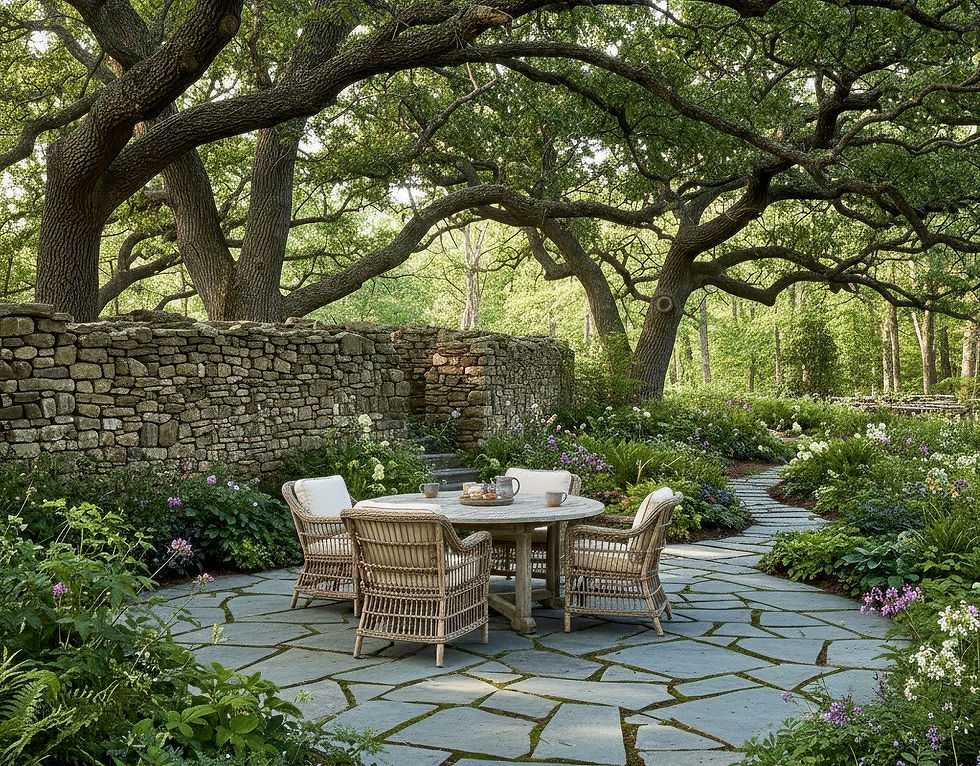
The finest gardens rarely peak immediately.
They deepen with time.
Trees gain character. Soil becomes richer. Planting settles into balance. Wildlife increases. The space develops atmosphere and permanence.
That only happens when decisions are made with maturity in mind from the start.
Professional garden design is ultimately about restraint, foresight and understanding natural processes - not simply creating a polished image for the first summer after installation.
If you are planning a garden redesign in Edinburgh, Glasgow or across Central Scotland, long-term thinking is one of the most valuable investments you can make.
A properly planned garden will not only look better over time - it will function better, cost less to maintain, and become more connected to the landscape around it.


Comments